The Distance Between Two Frames
On trust, direction, editing, and the strange abundance of a photographic archive.
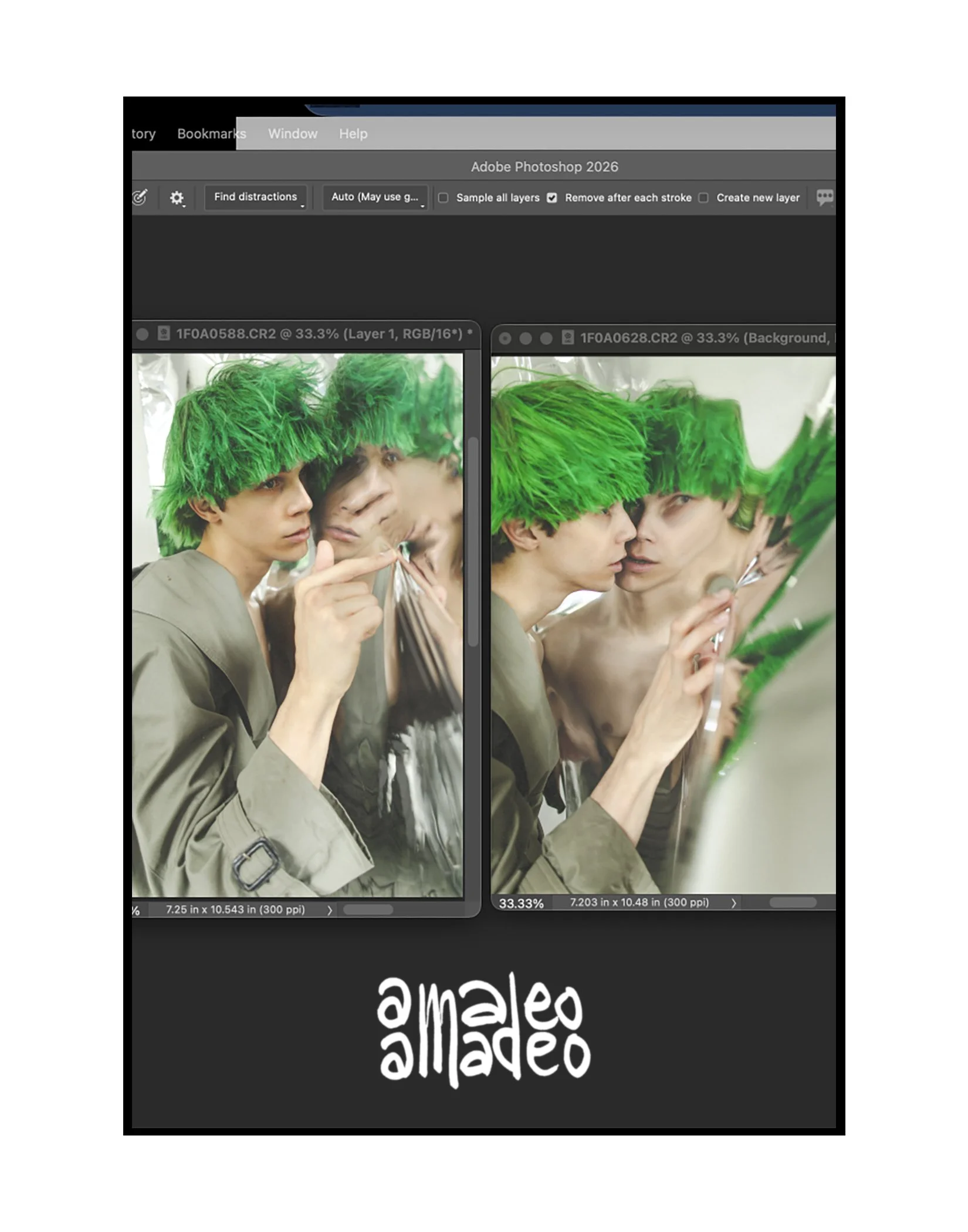
These two photographs were made within five frames of each other. Technically, almost nothing changed. The same model, the same light, the same Mylar mirror, the same room. Yet to me, they exist in completely different worlds.
In the first image, there is a quietness. The model seems absorbed by the reflection, as though he has momentarily forgotten that I am there. The folds of the garment, the softness of his expression and the repetition of his face inside the Mylar make the portrait feel inward and almost private.
The second image has a different tension. The faces move closer together. The body is more exposed. The reflection feels less like an echo and more like another person entering the frame. It becomes intimate, slightly confrontational and more surreal. Only a few seconds separate the two photographs, but the emotional temperature has completely shifted.
This is why editing is so important to me.
Photography is often discussed as the act of taking a picture, but so much of the work happens afterward, when I return to everything that occurred during the shoot. Editing is where I decide which fraction of a second contains the energy I remember—or perhaps reveals an energy I did not fully recognize while I was shooting.
The difference might be a softened mouth, a hand moving an inch, the direction of someone’s eyes or the exact moment a reflection becomes distorted. It may be the frame before a person settles into a pose, or the one immediately after they believe the photograph has already been taken.
Color grading changes that world again. A slight adjustment in the green, the warmth of the skin or the softness of the highlights can alter the emotional language of an image. The editing is never simply about making the photograph look better. It is about deciding what the photograph is trying to say.
The Mylar mirror makes that decision especially unpredictable. It never creates the same image twice. Every movement changes its surface. A face stretches, disappears and returns. One person becomes three, then five, then something that no longer looks completely human. The portrait is constantly rebuilding itself in front of me.
Directing someone inside that environment becomes its own strange conversation.
I might tell the model, “Look at me,” but I am not necessarily asking him to look toward the camera. I may be speaking to one of his reflections. I might ask him to move toward a face that exists only inside the mirror, or to follow the version of himself that has been pulled apart by the material. Sometimes I am directing the model; sometimes I am directing his reflection.
I work instinctively when I photograph. There are cues that come out before I have had time to intellectualize them. Look here. Move your chin slightly. Hold that. Forget about me. Look at yourself. Now look through yourself.
I like to move between images in which the subject acknowledges the camera and images in which they seem completely unaware of it. That variation creates its own rhythm. The direct gaze can feel powerful, but the moment immediately beside it—the glance away, the breath, the uncertainty—can reveal something entirely different.
None of this works without trust.
A model has to trust that I am not waiting for them to look bad. They have to believe that I am paying attention, that I will recognize the moments worth keeping and that I will not abandon them inside an uncomfortable gesture. My responsibility is to make the person feel secure enough to become casual, curious and strange.
I love directing models into poses, but I also direct through conversation. I may ask someone, “If you were a color, how would that color move through the air?” The question is not meant to produce a literal answer. It is meant to interrupt the person’s awareness of posing. Their body begins to solve the question before their mind can explain it.
A good photograph requires so many things to align: the model, the photographer, the light, the conversation, the clothing, the accident, the atmosphere and the shape that appears for only a moment. All of those things cooperate for perhaps 1/60th of a second.
Then they disappear.
Editing is where I search for them again.
Recently, I have been returning to shoots I photographed nearly a decade ago. Even after all that time, there are still frames I have never fully considered. I can open an old folder and immediately feel the personality of the person I photographed. I remember whether they were shy or extroverted, cautious or theatrical. I remember the energy in the room.
In the past few months, I have added hundreds of images from my archive to Tumblr. The collection has now grown to more than 12,000 portraits.
Sometimes I worry that people will think, That again? Another portrait? Isn’t this too much? Aren’t these nearly the same image?
Perhaps I simply like abundance.
I like seeing the infinite number of expressions that exist inside one face. I like the gestures people forget they made. I like the frames that appear almost identical until you spend time with them. One photograph may show confidence; the next, made a second later, may show doubt. A mouth closes. The eyes move. The posture softens. The person briefly returns to themselves.
The differences are minute, but they are not insignificant.
Looking through the archive also allows me to see how I have changed. My earlier photographs reveal a different understanding of direction. There were periods when I wanted the subject to appear completely in control. Now I understand that I can create the feeling of their control while remaining deeply involved in constructing the image.
That is one of the central illusions of portraiture: the subject appears to possess the moment, while the photographer quietly arranges everything around it.
My editing has evolved in the same way. What my eye notices now is light-years away from what it noticed ten years ago. The photographs have not changed, but I have. Images I once overlooked suddenly feel essential. A frame does not have one permanent meaning. It waits for the photographer to become capable of seeing it.
Perhaps that is why an archive never truly becomes finished. There will always be another expression, another reflection and another fraction of a second waiting to be rediscovered.
The magic of photography is not contained in one perfect image. It exists in the multitude—in all the nearly identical moments that reveal, upon closer inspection, that nothing ever happens exactly the same way twice.